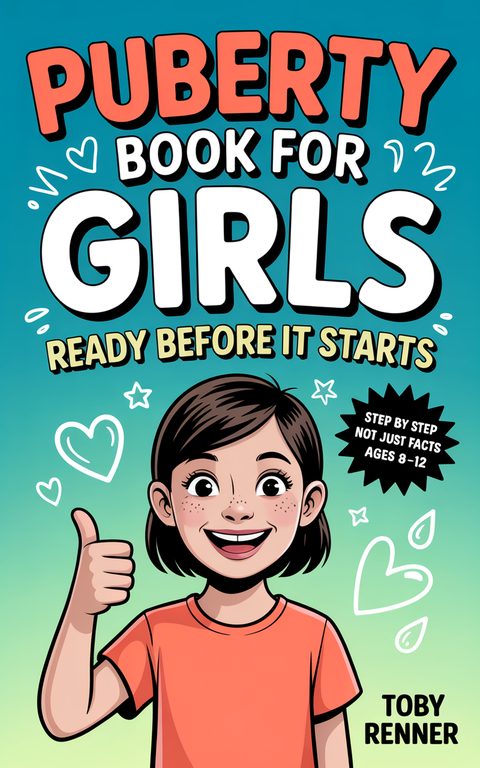
Who this book is for
A girl between eight and twelve who has started to notice that something is changing — or
who has noticed nothing yet and has begun to wonder why everyone else seems to have.
And, just as much, the adult standing next to her who wants to say something useful and is
not sure which words to use.
What makes it different
Most books on this subject explain what happens. The biology is not hard to find, and by
the time a girl needs it she has usually heard a version of it at school.
What she does not have is a plan for the ordinary Tuesday when it actually starts — in a
maths lesson, at a sleepover, on a long car journey, at two in the morning. That gap is what
this book fills. Every chapter answers a question that begins with what do I do, not
what is going on.
It opens with a page called Find It Fast: a plain table of situations — it started and
I am at school, it started and there is nothing in my bag, there is a queue for the party
bathroom — each pointing straight at the page that answers it. A girl who is worried right
now does not have to read a chapter to get help. She looks up her line and goes.
What is inside
- The first twenty minutes. Exactly what to do when it starts, hour by hour, through the
whole first day.
- At school. What to say to a teacher or the school nurse, what to keep in a backpack,
and what to do if someone finds out.
- Away from home. Sleepovers, other people's bathrooms, long journeys, swimming, sport.
- Words for the asking. Short scripted lines for the conversation that is hard to start —
including the version for when saying it out loud is too much.
- Pages made to be written on. A first-signs log, a month tracker, a mood strip, a
timeline with four boxes. They are printed to be filled in with a pencil.
- A glossary of every word she will hear, in the language she will hear it in.
- A page written for the grown-up — what to say, what not to say, and when to step back.
Full-colour illustrations throughout, and short comic strips for the moments that are easier
to see than to describe.
What this book does not do
It does not lecture, and it does not perform embarrassment on her behalf. It is written to
her, not about her, in a calm voice that treats her as someone capable of following a plan.
It is secular and faith-neutral. It carries no diagrams she would be mortified to be caught
reading. It does not tell her how she ought to feel about any of it.
A note on sources, and a boundary
The content was checked against trusted paediatric sources, including the American Academy of
Pediatrics, KidsHealth, the NHS and the Mayo Clinic.
It is an educational book written in plain language for young readers. It is not medical
advice. For any specific concern — pain that stops the day, something that does not look
like the book describes, a worry that will not settle — the right next step is a parent, the
school nurse or a doctor. The book says so in as many words, more than once.
For readers 8 to 12
Readable from eight, and written to stay useful through the first period and the year after
it. 142 pages, 6 × 9 inches, paperback and Kindle.
 Gatherwell Press