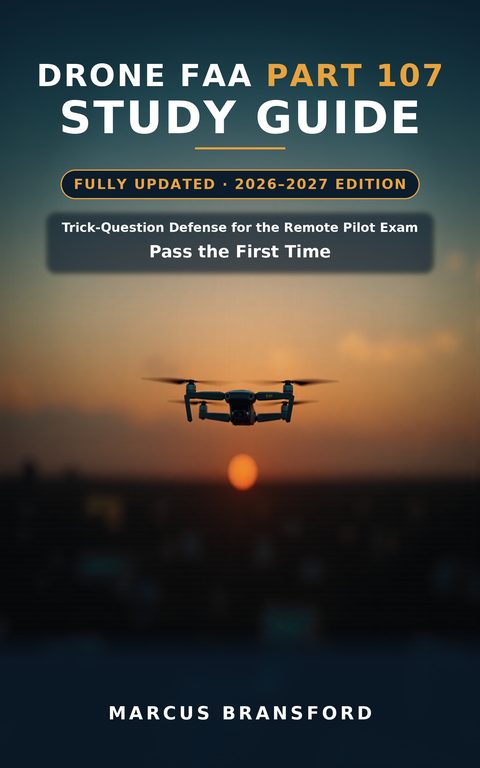
Who this book is for
Anyone sitting the FAA Remote Pilot exam — Part 107 — and paying for it out of their own
pocket. Hobbyists going commercial, surveyors and roofers adding a drone to the job,
photographers who have been flying for years and now need the certificate to charge for it.
No aviation background is assumed. If you have never read a sectional chart or heard of a
METAR, the book starts where you are.
The problem this book was written around
Most people who fail Part 107 do not fail because they did not study. They fail because the
exam is written to catch a specific kind of near-miss: an answer that is true in general and
wrong in the question asked.
A distance that is correct for one class of airspace and not another. A rule that changes
the moment the flight goes over people. A weather minimum that sounds familiar because it
belongs to manned aviation.
So this guide spends its time somewhere unusual: on why the wrong answers are wrong.
Every practice question is followed by an explanation of all four options — not just the
right one — because recognising the shape of a trap is what carries you through a question
you have never seen before.
What is inside
- Regulations and operating rules — 14 CFR Part 107, in plain sentences.
- Airspace and sectional charts — the classifications, and how to actually read the map.
- Aviation weather — METARs and TAFs decoded, and the flight decisions that follow.
- Loading and performance — weight, balance, and what changes in the air.
- Operations — crew roles, emergencies, physiology, maintenance, night flying, waivers.
- Remote ID — a full chapter on 14 CFR Part 89 and what compliance means in 2026.
- Trick questions and most-missed — the traps, named and dismantled.
- Two full-length practice exams, each with an explanation for every answer.
- A numbers quick-reference for the last hour before the test.
- What changed — the 2026 updates and how to stay current, including recurrent training.
Colour throughout where colour carries meaning: airspace shading, chart symbols and weather
diagrams do not survive being printed in grey.
An honest note about the promise
The subtitle says pass the first time, and that is the aim of the book. It is not a
guarantee, and no study guide can make one. The exam is administered by the FAA at a testing
centre, the question pool is theirs, and passing depends on the work you put in.
What a guide can do is make sure nothing on the exam is a surprise, and that you have already
met the traps somewhere safe.
Currency, and a boundary
Regulations move. The book states the rules as of the 2026–2027 window and closes with a
chapter on staying current, because a certificate that lapses is worth exactly as much as one
never earned.
For anything binding — an airspace authorisation, a waiver, the current text of a rule — the
FAA is the authority, not this book. The guide is preparation, not a legal reference.
234 pages, 6 × 9 inches
Paperback and Kindle.
Optional
Want to hear about new books?
A couple of notes a month, nothing more. Unsubscribe in one click, anytime.
Double opt-in — we send a confirmation link first, and nothing until you click it.
See our privacy policy.
 Gatherwell Press