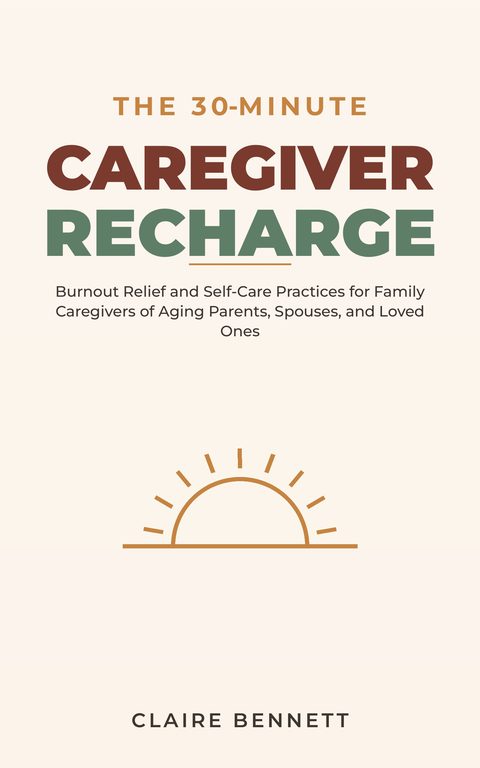
Who this book is for
Someone looking after a parent, a partner or a child who needs more help than one person can
comfortably give — and who has stopped counting how long it has been going on.
You already know the advice. Sleep more. Take time for yourself. Ask for help. None of it
survives contact with a Tuesday.
Why it is short on purpose
Most self-care books are written for people who have an evening. A caregiver does not have an
evening. She has the eleven minutes between one thing and the next, and she is not going to
spend them reading about the importance of rest.
So every practice here fits inside the time you actually have. Not a spa day, not a routine,
not a lifestyle. Something you can do in the car park, in the corridor, or standing at the
kettle while the water boils.
Nothing in the book requires equipment, privacy, money, or anyone's permission.
What is inside
- You're not doing this wrong. Why the usual advice keeps failing, and what changes when
you stop treating that as a personal failing.
- The five-minute nervous system recharge — the practice the rest of the book leans on.
- Recharging on no sleep, which is the condition most of this is done in.
- Letting go of the guilt — without pretending that is easy, or that naming it is enough.
- Saying no when you can't say no — the sentences that hold a line without a fight.
- Staying a person — reconnecting with who you were before this became the whole day.
- When you have zero minutes — recharging inside the day rather than after it.
- Your recharge plan — a short chapter to make the rest of it yours.
What this book does not do
It does not ask you to reframe the situation as a gift. It does not suggest you would cope
better with a more positive attitude. It does not require you to explain yourself to anyone.
And it does not pretend the difficulty is in your technique. Caregiving is genuinely hard;
the practices here are for the person doing it, not a substitute for the help she is owed.
A boundary worth saying plainly
This is a short book of practical self-care. It is not medical or psychological
treatment. Burnout can shade into depression and anxiety, and when it does the right next
step is a doctor — not a better breathing exercise.
If the exhaustion has stopped lifting at all, if the low mood is constant, or if you have
thoughts of harming yourself, please speak to a professional. The book says the same thing,
in the same words, where it belongs.
44 pages, 6 × 9 inches
Short by design — a book you can finish in one sitting and use the same afternoon.
Paperback and Kindle.
Optional
Want to hear about new books?
A couple of notes a month, nothing more. Unsubscribe in one click, anytime.
Double opt-in — we send a confirmation link first, and nothing until you click it.
See our privacy policy.
 Gatherwell Press